By David Strickland, COO of Kenton Brothers
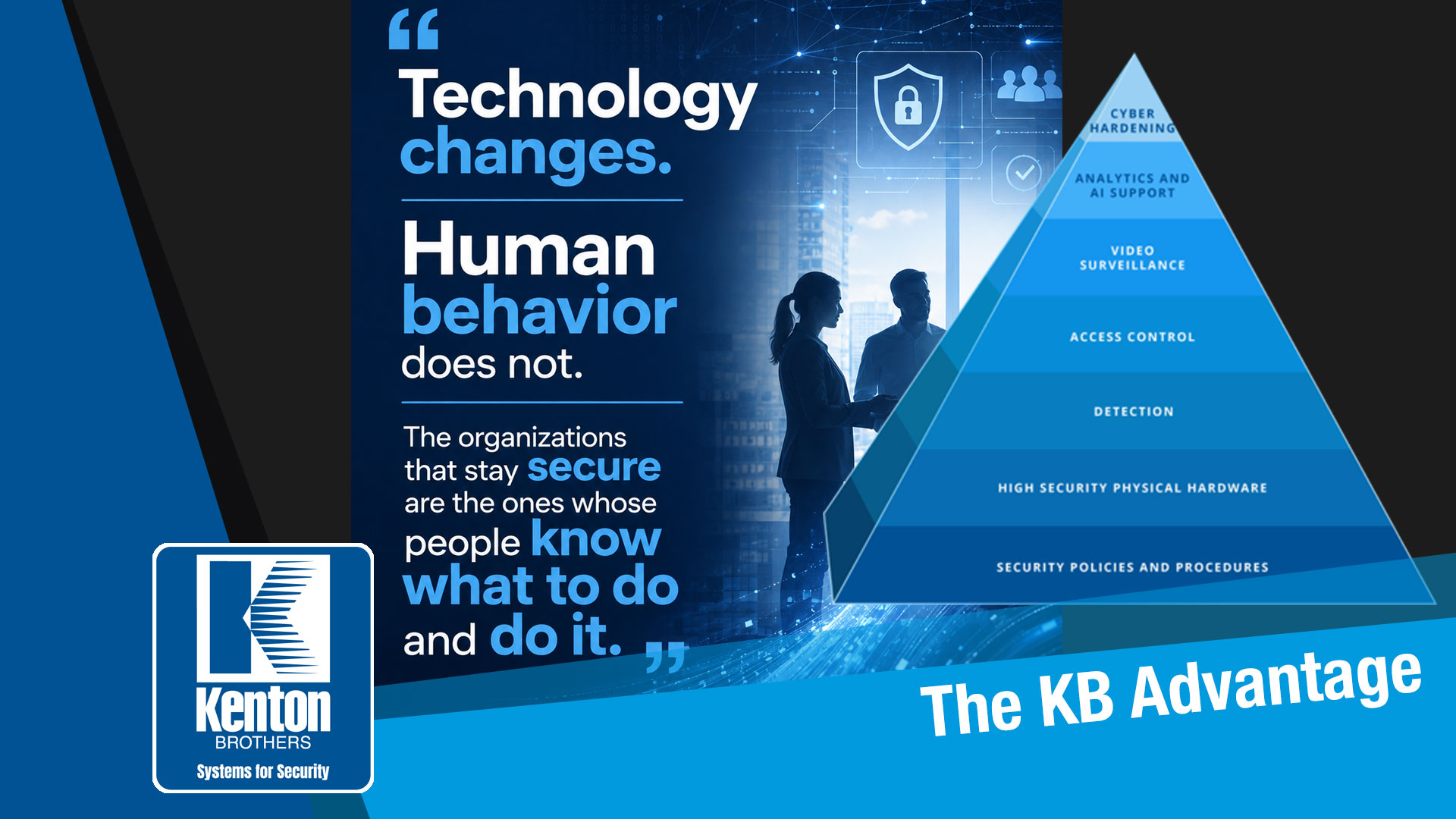 Ask any seasoned security professional what they would fix first after an incident, and the answer is rarely a camera or a card reader. It is almost always a process. Somebody propped a door open for a delivery. Somebody lent a badge to a coworker. Somebody skipped the visitor log because it was a busy Tuesday. The technology was in place. The discipline around it was not.
That pattern is not an accident, and it is not rare. In our experience, the overwhelming majority of security failures trace back to a person not following a policy, or to a policy that was never written in the first place. The hardware did its job. The organization did not ask it to.
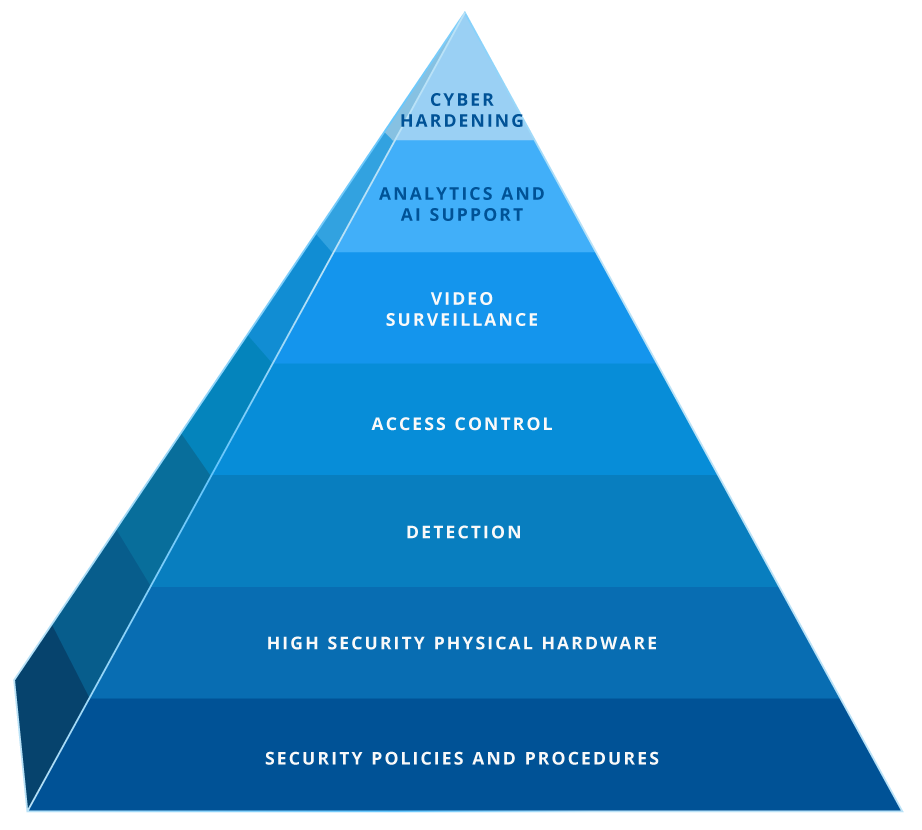
This is why the Kenton Brothers technology stack is built the way it is. We have organized everything we deliver into seven layers, and the widest, heaviest, most load bearing layer of all is not a product. It is your security policies and procedures, written around the specific needs of your organization.
The KB Advantage Pyramid: seven layers of protection, each one supported by the layer beneath it.
Cyber Hardening
The process of securing a computer system/network/application to make it more difficult for attackers to gain access to data resulting in unauthorized usage of information, theft or damage.
Analytics/AI support
The use of data and image analysis, machine learning and artificial intelligence to enhance decision making and problem solving.
Video Surveillance
The use of cameras to watch and record people, places or activities for security, safety or monitoring purposes.
Access Control
Electronically securing a facility to limit entry to authorized individuals.
Detection
Intrusion Detection, Perimeter Detection, Weapons Detection, Threat Detection
High Security Mechanical Locking Hardware
Commercial locks and related components that provide advanced protection against tampering, picking, key duplication and other forms of unauthorized access.
Security Policies and Procedures
Visitor management, compliance, background search, penetration testing, system health monitoring, maintenance, training
The Foundation Is Not Optional
A pyramid stands because its base is wider than everything above it. Security works the same way. Every reader, sensor, camera, and analytic we install is only as effective as the rules that govern how people interact with it. Who is allowed where, and when? What happens when a credential is lost? Who reviews the audit trail, and how often? What is the escalation path at 2:00 AM when an alarm trips at a remote site? If those questions do not have written, agreed upon, trained answers, the technology above them is resting on sand.
Two things make our approach to this layer different. First, we do not hand you a template. Policies and procedures have to be built around the needs of your organization: your facilities, your people, your risk profile, your regulatory obligations, and your culture. A distribution center, a school district, a bank branch, and a state agency should not share the same visitor management procedure, and at KB they do not. Second, we treat this work as a security deliverable, not a paperwork exercise. It is scoped, documented, trained, and revisited, because a procedure nobody follows is not a procedure at all.
Most security failures are not technology failures. They are moments when a person did not follow a procedure, or when no procedure existed to follow. Get this layer right and everything above it gets stronger. “Technology changes. Human behavior does not. The organizations that stay secure are the ones whose people know what to do and do it.”
Seven Layers, Bottom to Top
Here is how the stack builds. Read it from the base up, because that is how it works in the field: each layer depends on the integrity of the ones beneath it.
1 – Security Policies and Procedures
The foundation. Access levels, key and credential control, visitor management, incident response, alarm escalation, audit and review cadence, and the training that makes all of it real. Built around your organization, not pulled from a binder. This is the layer that determines whether every dollar above it performs.
2 – High Security Physical Hardware
Doors, frames, locks, closers, restricted keyways, and high security cylinders. This is where Kenton Brothers began in 1897, and it is still where a surprising number of breaches begin: a door that does not latch, a keyway that was duplicated at a hardware store, a strike that was never adjusted. Electronic security cannot compensate for an opening that is physically weak.
3 – Detection
Intrusion detection, perimeter sensing, glass break, motion, and environmental monitoring. Detection is how the building tells you something has changed, and the quality of that signal sets the ceiling on how fast your team can respond. We design detection to produce actionable alarms, not noise.
4 – Access Control
Credentials, readers, controllers, and the software that decides who goes where. Done well, access control is also your record of truth: every entry logged, every exception visible, every departed employee removed the same day. Integration with your HR and IT systems is what turns access control from a lock into a living policy engine.
5 – Video Surveillance
Cameras, recording, and viewing designed for verification, deterrence, and evidence. Video is the layer that confirms what detection and access control report, and it is only useful when coverage, retention, and image quality were engineered against your actual risk, not against a camera count.
6 – Analytics and AI Support
The intelligence layer. Object and behavior detection, cross system correlation, and automated alerting that lets a small team supervise a large footprint. Analytics do not replace people; they make sure people are looking at the right thing at the right moment, and they make the data underneath actually usable.
7 – Cyber Hardening
The layer that protects everything else. Every device we install is a networked computer, and every networked computer is an attack surface. Firmware management, credential hygiene, network segmentation, encrypted communication, and ongoing vulnerability review are built into our deployments through our CYPHY cyber and physical convergence program. A camera with a default password is not a security device. It is an open door.
Why the Order Matters
It is tempting to buy from the top of the pyramid down. AI analytics are exciting. Cyber hardening is in the headlines. But analytics running on cameras that were never positioned correctly produce confident, useless alerts. Access control mounted on a door that does not close is a very expensive suggestion. And all of it, from the smartest analytic to the simplest sensor, is undone the moment an employee holds the door for a stranger because nobody ever told them not to.
When we sit down with a new client, we start at the bottom. We look at what is written, what is actually practiced, and where those two things diverge. Then we look at the openings themselves. Only then do we talk about what to detect, what to control, what to watch, what to analyze, and how to protect the whole system from the network side. This is slower than quoting a camera package. It is also the only approach that produces a system your organization can actually run.
One Banner
Most organizations already have pieces of this pyramid. The locks came from a locksmith. The alarm came from an alarm company. The cameras came from an IT vendor. The access control came from whoever the general contractor used. The policies, if they exist, were written by someone who left three years ago. And when something goes wrong, each of those vendors can point at the others.
Kenton Brothers delivers every layer of this stack under one banner. Not a locksmith who resells cameras, and not a video company that subcontracts doors. One team designs the policy framework, specifies and installs the physical hardware, builds the detection and access control, engineers the video and analytics, and hardens the network that ties it all together. One point of accountability. One service relationship. One partner who understands how the layers depend on each other because we built all of them.
No one else offers all of this under one banner. That is not a slogan. It is the reason our clients call one number when something matters.
129 Years of Knowing What Works
Kenton Brothers has been securing Kansas City and the region since 1897. We have watched security technology move from keys to cards, from cards to credentials on a phone, from analog video to AI driven analytics, and from isolated hardware to networked systems that need to be defended like any other piece of enterprise IT. Through every one of those transitions, the constant has been this: technology changes, and human behavior does not. The organizations that stay secure are the ones whose people know what to do and do it.
That perspective is the KB Advantage. It is the reason we lead with policy and procedure. It is the reason we still take door hardware seriously when others treat it as a commodity. It is the reason we were named a national Top 10 Law Enforcement Solution Provider in 2021, and it is the reason we invested in cyber and physical convergence before it was a buzzword. Seven layers, one banner, and more than a century of watching what actually keeps people and property safe.
Where to Start
If you are not sure how many of the seven layers your organization has in place, or whether the foundation under them is solid, that is exactly the conversation we want to have. A KB security assessment begins with your policies and procedures, walks every layer of the pyramid against your real risk, and produces a clear picture of what is strong, what is missing, and what to do first.
Talk to a Kenton Brothers security consultant today. All Secure Since 1897.



Leave a Reply
Want to join the discussion?Feel free to contribute!